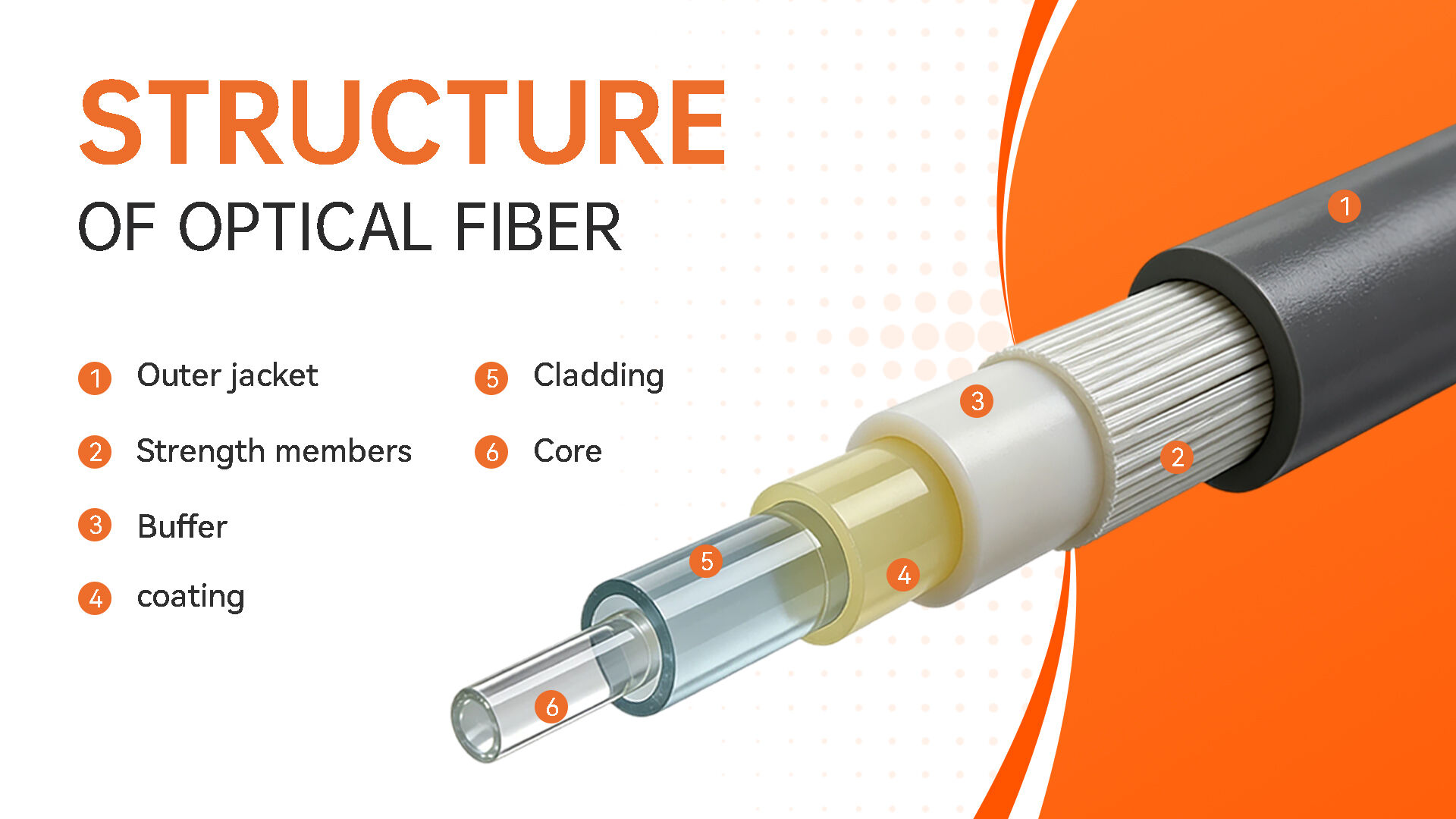
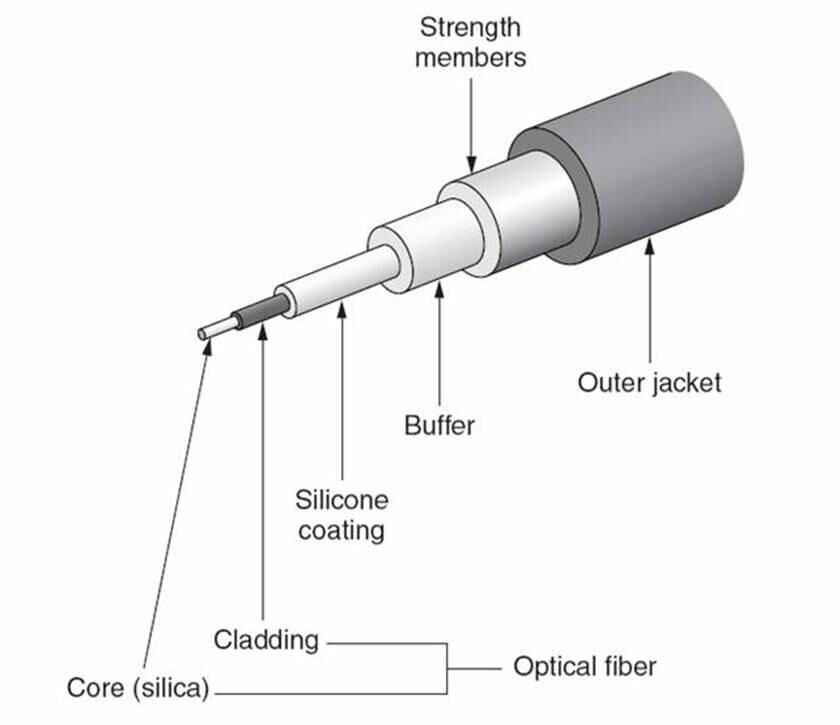
The Structure of an Optical Fiber
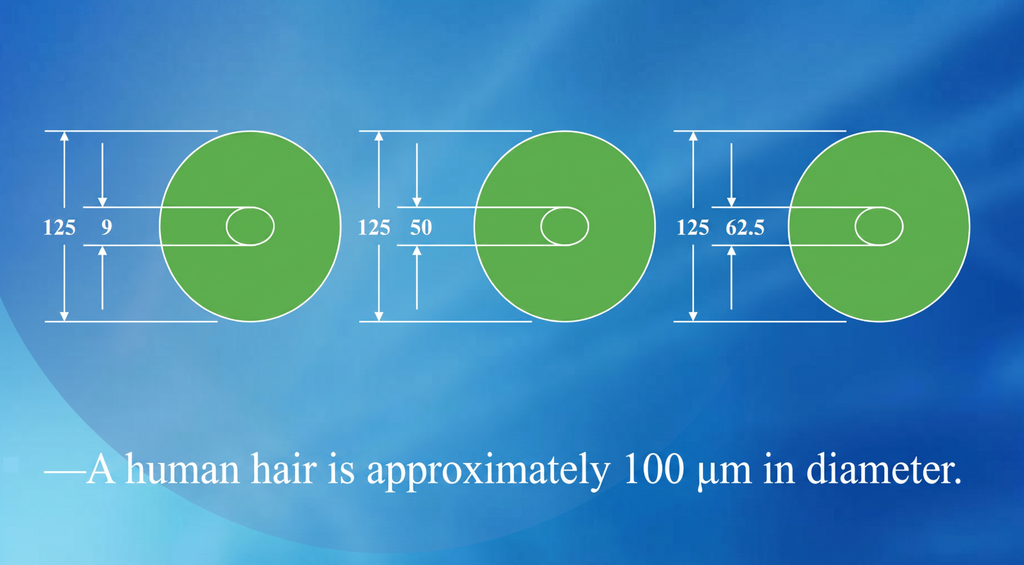
- Fiber Core: The central glass core has a high refractive index. Typical diameters are 8 μm, 50 μm, or 62.5 μm.
- Fiber Cladding: The core is surrounded by lower-refractive-index glass cladding, typically 125 μm in diameter. The cladding confines the light within the core and isolates it from the surrounding environment.
- Fiber Coating: The outermost layer reinforces and protects the glass fiber.
Common Types of Optical Fiber
1. By transmission mode: single-mode and multi-mode fiber (MMF)
Single-mode fiber: Single-mode fiber has a small glass core, typically 9 or 10 μm in diameter, and supports only one mode of propagation. It therefore has negligible intermodal dispersion and is well suited to long-distance communications. Chromatic dispersion is the more important limitation, so the optical source must have a narrow spectral width as well as a good wavelength stability.
Single-mode fiber: OS1
Multi–mode fiber (MMF): Multi-mode fiber has a larger glass core, typically 50 or 62.5 μm in diameter, and supports multiple propagation modes. Its higher intermodal dispersion limits bandwidth, and the effect becomes more pronounced as distance increases. For example, a fiber rated at 600 MB / km would provide only 300 MB of bandwidth over 2 km. Multi-mode transmission is therefore generally limited to relatively short distances, usually no more than a few kilometers. Multi-mode fiber is further categorized as OM1, OM2, OM3, and OM4.
2. By optimum transmission window: conventional and dispersion-shifted single-mode fiber
Conventional single-mode fiber: The fiber is optimized for transmission at a single wavelength, such as 1,300 nm.
Dispersion-shifted single-mode fiber: The fiber is optimized around two wavelength regions, such as 1,300 nm and 1,550 nm.
3. By refractive-index profile: step-index and graded-index fiber
Step-index fiber: The refractive index changes abruptly at the boundary between the core and cladding. This design is inexpensive but produces relatively high intermodal dispersion, making it suitable for short-distance, low-speed communications such as industrial control. Because single-mode fiber has negligible intermodal dispersion, it normally uses a step-index profile.
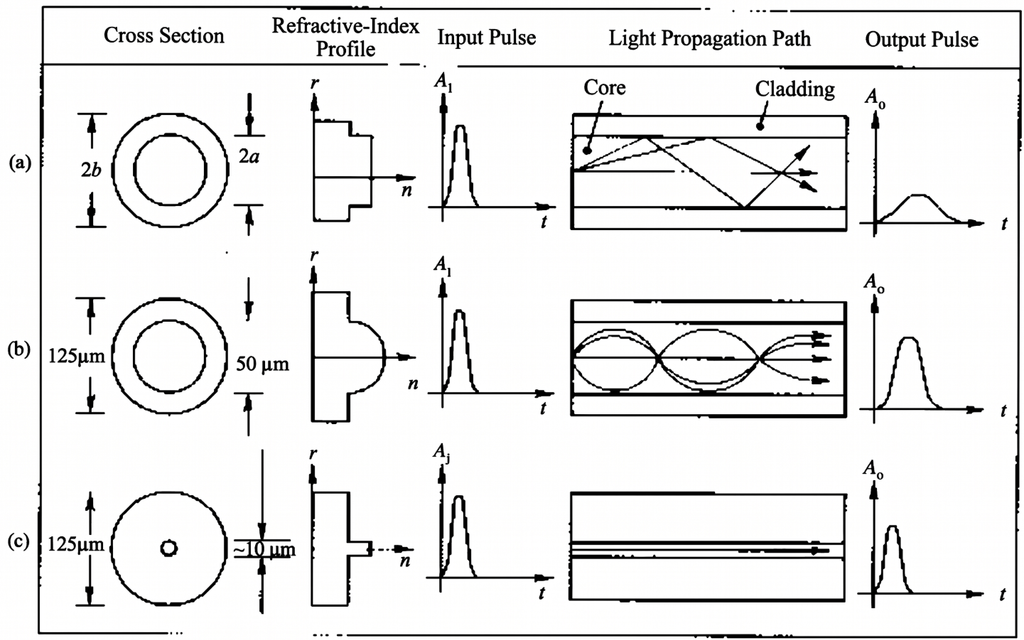
Graded-index fiber: The refractive index gradually decreases from the center of the core toward the cladding. This causes higher-order modes to follow curved paths, reducing intermodal dispersion, increasing bandwidth, and extending transmission distance. Although it costs more, most modern multi-mode fiber uses a graded-index profile.
Advantages of Optical Fiber
- Extremely wide bandwidth – the theoretical value can reach approximately 3 billion MHz.
- Long unrepeatered transmission spans, ranging from tens of kilometers to more than 100 km, compared with only a few hundred meters for copper cable.
- Immunity to electromagnetic fields and electromagnetic radiation.
- Low weight and compact size. For example, a 900-pair twisted-pair cable carrying 21,000 voice channels is about 3 inches in diameter and weighs 8 metric tons per kilometer. A fiber-optic cable with ten times the communications capacity can be about 0.5 inch in diameter and weigh 450 lb per kilometer.
- No electrical current in the transmission medium, making fiber safer for use in flammable or explosive environments.
- A broad operating-temperature range.
- Resistance to chemical corrosion and a long service life.
Common Fiber Specifications
Single-mode: 8/125 μm, 9/125 μm, and 10/125 μm
Multi–mode: 50/125 μm (European standard) ; 62.5/125 μm (U.S. standard)
Industrial, medical, and low-speed networks: 100/140 μm and 200/230 μm
Plastic optical fiber: 98/1,000 μm; used in automotive control systems
From its core and cladding to its protective coating, optical fiber may appear structurally simple. Its outstanding transmission performance, however, has made it a fundamental part of modern communications networks. Whether single-mode or multimode, each type of fiber offers distinct technical advantages for specific applications.
As 5G, FTTH, data centers, cloud computing, and artificial intelligence continue to develop, networks must deliver higher speeds, greater capacity, lower latency, and greater reliability. As a result, fiber-optic communications are becoming increasingly important.
Understanding the basic structure, classifications, performance characteristics, and common specifications of optical fiber helps network planners select the right fiber for each application and provides a reliable foundation for stable, efficient, and future-ready communications networks.
Let every beam of light connect us to a faster, farther-reaching, and more connected future.