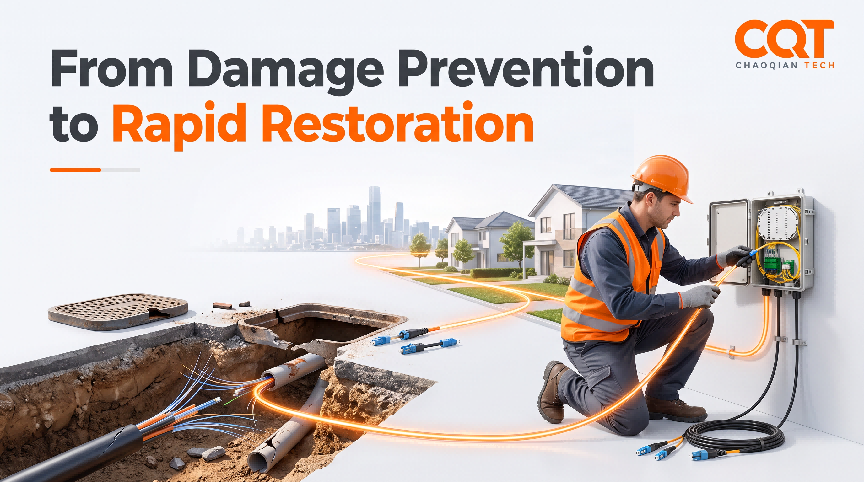
On September 21, 2026, airports across the Northeastern United States were hit by a major air traffic control (ATC) outage. The cause was simple. An aging primary circuit serving the FAA’s Philadelphia TRACON failed, and when the system switched to its backup, officials found that a construction crew working for NJ Transit had accidentally cut the backup fiber-optic line in New Jersey. More than 1,000 flights were canceled and over 6,000 were delayed nationwide. Yet, the outage was by no means a rare event. According to CGA’s 2025 DIRT Data Summary & Trends, there were 221,717 unique reports of utility damage in 2025, and 51% of which involved telecom or MSO/CATV lines and facilities. The CGA Index, which measures the intensity of damage each year, rose from 96.7 in 2024 to 102 in 2025, a 5.48% increase and for the first time exceeding its 2022 benchmark of 100. The CGA estimates that damages to underground utilities cost the U.S. economy $83.2 billion a year. With digital infrastructure still being built out at scale, there is little reason to expect the 2026 figures to be lower.
The numbers convey a clear message. Damage to underground utility lines has not declined despite the progress in technology and management; instead, it has risen alongside the large-scale build out of digital infrastructure. Paradoxically, fiber networks benefit from this build out, but are also increasingly exposed to its risks. The CGA data show that about 30% of damages to telecom/CATV facilities were caused by telecom project site work itself. The remaining 70% came from water, natural gas, electric, and road construction, which are beyond telecom operator’s reach. As infrastructure build out continues upgrades, fiber optics will operate in an increasingly complex environment.
Vulnerabilities Exposed
The consequences of a single accident goes beyond the visible physical damage. From the internet backbone and intercity fiber routes down to FTTH terminals, fiber optics carry the optical signals that mirror real-world conversations, information, and transactions. When service breaks down, the calculation of economic loss expands well beyond the network into the physical world. Rather than counting repair costs alone, the CGA calculates the cost of damage across five dimensions, including direct repair and operational response costs. As fiber networks carry an ever-growing load of the physical world, the potential loss from any outage or damage will keep rising.
Preventive measures are still the first line of defense, including 811 notification, accurate locating and marking, verification, and safety practices at project sites. Yet, no damage prevention system can reduce the probability to zero. For the residual risk statistically bound to occur, damage mitigation and rapid response deserve equal attention. Even with an effective multi-party response, restoring the FAA’s fiber connection took more than eight hours before the affected ATCs could fully resume their operations.
On-site fiber restoration is complex and requires coordinated work by professionals from multiple fields: route and port identification, fault location, spare-parts logistics, fusion splicing, verification testing, and service restoration. The total time for reparation is usually set by the slowest step in the process. For high-fiber-count cables, fusion splicing is the most time-consuming and labor-intensive procedure. Factors such as the technician’s experience, adverse weather, cramped manholes, and operation time can even prolong the mean time to repair (MTTR).
What Can We Do About It
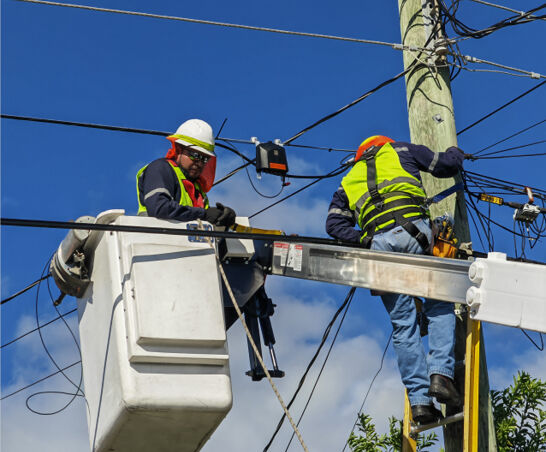
If damage cannot be eliminated, the network design has to bear in mind with restoration. Conventional components are meant to be assembled or spliced on site, which consumes time and effort. Pre-connectorized (or pre-terminated) products outsource that work to the standardized factory, with little or no skill-intensive work is left to the field. The reparation thereby becomes plug and play, instead of rebuilding a joint inside a manhole. This does not make splicing obsolete, especially on high-fiber-count trunk cables, but it fits the distribution and drop sections, where connection points are the most numerous. Three characteristics make pre-connectorized solution noteworthy: industrial-grade precision, tested strength and resilience, and plug-and-play deployment.
The first is precision. The loss of a splice connection depends on end-face geometry, cleanliness and alignment, none of these permits much error. In practice, the result also depends on the technician, the weather and the dust in the air, so two repairs on the same cable can end up with different quality. A factory can polish, assemble and test each components under controlled conditions before it ships. For a restoration, this means the replacement part arrives with a known performance.
The second is strength and toughness. Repair points rarely take place in gentle environments: aerial strands, handholes and manholes involve pulling, bending, rain, corrosion, UV, and extreme temperature. A connector that passes an optical test on the bench can still fail outdoors. Factory-built products can be put through tensile, impact, water and environmental tests before shipment, which gives the operator a datasheet instead of relying on the crew’s workmanship.
The third is plug-and-play deployment. Fusion splicing needs a splicer, a power source, a clean, a sheltered workspace, and a technician. Any of these can be missing at night, in the rain, or at a pole far from the road. A plug-and-play connection needs none of them, so more crews are qualified to do the work and service can come back sooner. Splicing may still be needed later for a permanent fix, but it can then be scheduled instead of being done under outage pressure. Every hour saved here is an hour off the outage, and as the earlier paragraphs argued, the cost of an outage keeps growing.
CQT‘s Practice
CQT’s pre-connectorized products come in two generations. The first generation uses plug-and-play connections without field fusion splicing. Its connector is 40% smaller with a construction OPEX falls by 20%. The hardened connector has an insertion loss of 0.4 dB maximum and 0.2 dB average, with a tensile rating of up to 500 N for two minutes in its strongest version. The second generation, Marvel solution, adopts the Sticklok connector, which complies with GR standards. The connector is small enough to be used underground, with a 0.4 dB maximum insertion loss, 0.2 dB average and -65 dB return loss. Marvel solution comes with MTS, MTC and MTT terminal boxes with more than 35 single-fiber configurations, so operators can match the product to different layouts and keep matching spares in stock.