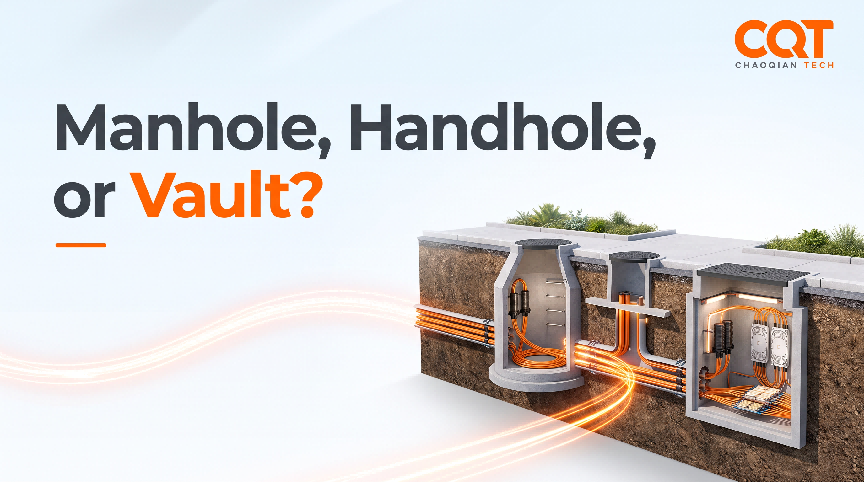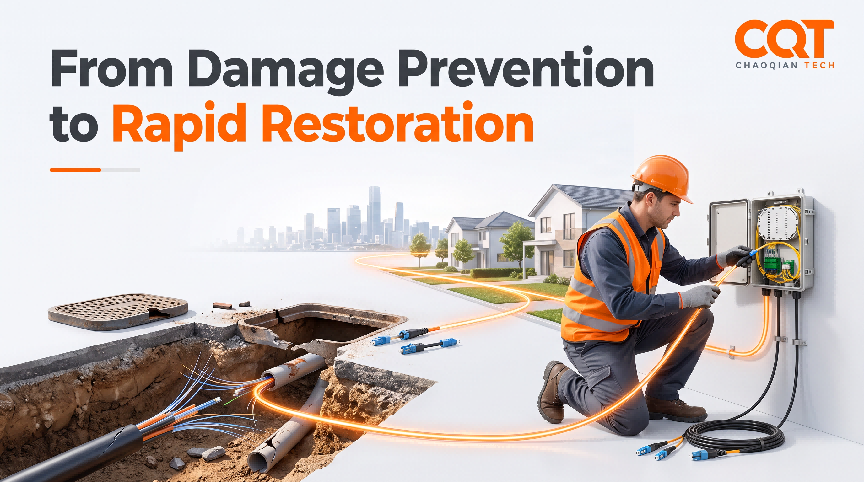
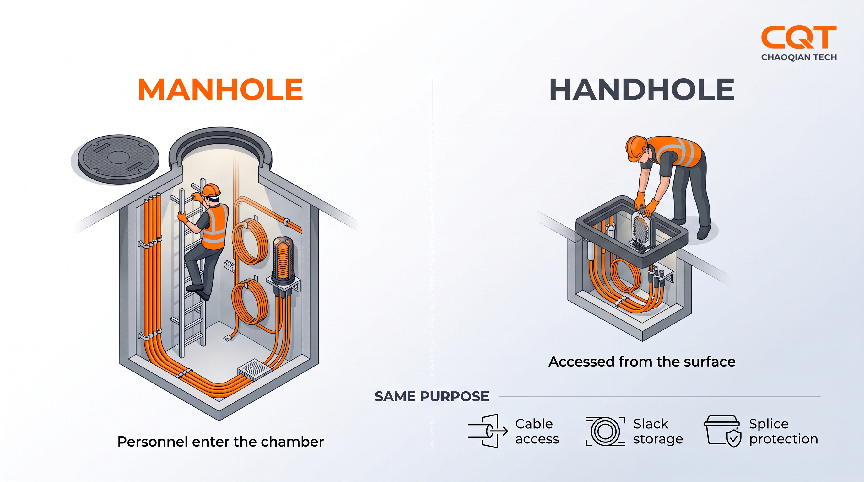
In underground fiber networks, the simplest way to distinguish a manhole from a handhole is to ask where the technician works. A manhole is designed for personnel entry, while a handhole is accessed from the surface. Both provide access to buried ducts, cables, slack loops, and splice closures. The term “vault” is less precise: depending on the standard or supplier, it may describe a personnel-entry utility space or a larger underground enclosure. So the name alone is not enough. The key questions are whether personnel are expected to enter and what installation or maintenance work the structure must support.
Same purpose, different access
Manholes and handholes often perform the same basic functions. Either may be used as a pulling point, a place to store cable slack, or a location for a splice closure. A manhole adds room for technicians to work below ground; a handhole must allow the same equipment to be handled from above. That is why neither network type nor fiber count automatically determines the choice. The right structure depends on the equipment, cable layout, and work planned for that location.
Before selecting a size, check four things:
- The number, position, and diameter of duct entries.
- The size of the splice closure and the space needed to open or remove it.
- The cable manufacturer’s bend-radius requirements and the diameter of the stored slack loops.
- Any realistic allowance for future cables, branches, or an additional closure.
- A closure fitting inside the chamber does not mean the chamber is large enough. Crews must also be able to reach it, move it into a working position, and return it without pinching or over-bending the cable.
Maintenance, safety, and cost
The access method becomes especially important during maintenance. At a handhole, technicians normally work from the surface, so the cable layout needs enough slack and a clear removal path. A manhole allows personnel to enter, but entry brings additional safety controls. For U.S. telecommunications work covered by OSHA 29 CFR 1910.268(o), these include guarding the opening, testing the atmosphere, and ventilating when required. Even when personnel can enter the chamber, fiber splicing does not have to take place underground; sufficient slack may allow the work to be completed in a splicing vehicle or another suitable work area.
Cost should be evaluated in the same practical way. A smaller handhole may reduce excavation and lifting, but only if it still provides enough capacity and meets the site’s structural requirements. Compare the full installed cost – including excavation, bedding, placement, backfill, surface restoration, maintenance, and future expansion – rather than the enclosure price alone.
Load rating depends on location
The terms “manhole” and “handhole” do not indicate how much load a structure can carry. Suitability depends on the complete installed system: the cover, frame, enclosure body, support, backfill, and surrounding surface. In North America, ANSI/SCTE 77 addresses grade-level enclosures used in non-deliberate traffic areas, where occasional vehicle loading may occur but direct traffic is not intended. Locations where vehicles are expected to pass directly over the enclosure may require an applicable AASHTO specification instead. In Europe, EN 124 classifies manhole-top and gully-top assemblies for pedestrian and vehicular areas. It applies to the cover and frame assembly and should not be treated as automatic certification of the entire underground chamber.
Water protection has three layers
Water protection should not be reduced to a single claim such as “the chamber is waterproof.” An underground installation has three separate protection points:
- The chamber and cover manage access, loading, drainage, and surface-water entry.
- Duct and wall entries control water, dirt, or gas paths around cables and conduits.
- The splice closure protects the fiber joint and its cable entries.
Each layer needs its own evidence. An IP68 rating on a splice closure does not make the surrounding chamber watertight. It is also important to check the actual IPX8 test conditions, because IEC 60529 does not assign one universal immersion depth and duration to every IP68 product. The test pressure or depth, duration, cable-entry configuration, and report should match the intended application.
CQT products for underground fiber
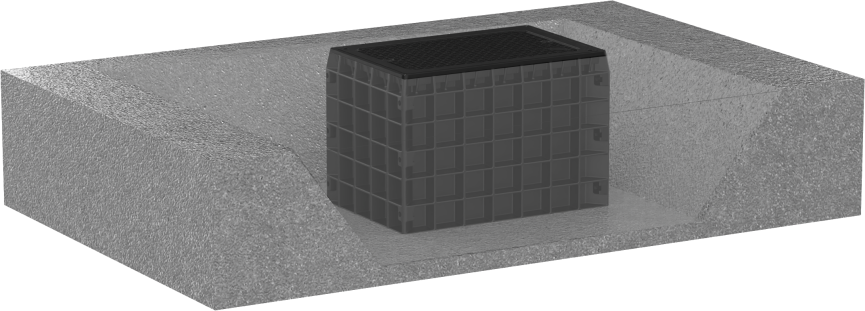
CQT supplies both underground enclosures and fiber-optic splice closures, allowing the chamber layout and the joint protection to be reviewed together. The GPJ09-JZ-04 modular underground enclosure measures 914.4×609.6×609.6 mm and uses an SMC cover with BMC side panels. CQT lists an operating temperature range of -40℃to +65℃and RoHS-compliant materials for this model. Because the published product name is “Manhole” but the enclosure is relatively compact, the project should confirm whether it is intended for personnel entry rather than relying on the name alone.
For splice protection, CQT’s GPJ09-6806 horizontal closure is listed as IP68 and uses a mechanical sealing system with non-vulcanized sealing tape. It is suitable for underground installation. Before approval, the cable diameter, cable-entry arrangement, sealing accessories, and IP test conditions should be checked against the ordered configuration. The closure’s ingress-protection rating, the chamber’s structural performance, and the cover’s load rating are separate requirements and should be supported by separate documents.
Check certification by model
For European or North American projects, a general statement that a product is “compliant” is not enough. The document must match the model, component, and configuration being purchased. For example, EN 124 evidence should identify the applicable cover-and-frame assembly and load class, while ANSI/SCTE 77 evidence should identify the tested enclosure assembly and tier. RoHS documentation addresses restricted substances; it does not prove load capacity or water sealing. CQT’s public information for the GPJ09-JZ-04 identifies RoHS material compliance, but it does not identify model-specific EN 124 or ANSI/SCTE 77 certification. If either standard is required, the corresponding certificate or test report should be included in the project submittal.
Support after delivery
Product support matters before installation and throughout the service life of the network. CQT states that its R&D team can assist with model selection and configuration, that installation instructions are available for most products, and that overseas quality issues can be assessed remotely using a fault description, photographs, and the product serial number. For a specific project, these general services should be converted into clear deliverables: an approved drawing, a locked bill of materials, a confirmed sealing-parts list, installation instructions, compatibility checks for repeat orders, and written approval before any material or design change. Warranty period, response time, remedies, training, on-site support, and version-change notification should also be defined in the contract rather than assumed from a general website statement.
Choosing between a manhole, handhole, and vault is ultimately about how the site will be installed and maintained. Start with access and working space, then verify loading, water protection, compliance documents, and long-term support. The correct choice is not simply the largest chamber or the lowest purchase price – it is the structure and equipment combination that crews can install, service, and expand safely over the life of the network.