
The Real Constraint Isn’t Bandwidth — It’s Uplink Asymmetry, Unreliable Connections, and a Labor Shortage that Reaches Every Single House
Originally drawn from purified sand and coated with a rubber-like polymer skin, optical fiber now carries almost everything in the digital world in its purest form: light. As hyperscalers pile into the data centers and the wider AI build-out, optical modules and their components have drawn public attention the industry hasn’t seen in decades. That attention, however, lands unevenly. The scramble at the finished-goods end has tightened supply across the board and lifted prices along the upstream glass chain – high-purity quartz, preforms, and drawing capacity.
The bill shows up as a cost squeeze in broadband access sector. Local internet service providers (LISPs) are reconsidering downgrading their FTTx hardware configurations. ODN hardware suppliers, mostly small-to-mid size manufacturers on the other side of the Pacific, are pivoting to the data center businesses for fatter margins. Policy uncertainty around subsidy programs, like BEAD and RDOF, prompted numerous infrastructure PE funds to divest their in-service FTTH networks. One complaint recurs: “Who knew fiber costs would explode 800% this year?” Yet, it is at this end of the network, not in the data centers, that the price of delivering AI to households actually gets set.
The industry’s grumbling rests on a stark mismatch of capital spending. According to MTN Consulting’s market trackers, hyperscalers booked $507 billion of capex in 2025, a 65% jump YoY, and nearly all of it going into data center construction and operation. Yet the global telco sector, by contrast, only managed $296 billion in aggregate capex, with a -0.9% YoY rate of decline. The equipment line alone in hyperscaler capex, $300 billion, now roughly matches what the entire telecom industry spends on everything. Revenues are not the constraint: telecom revenues grew 3.5% to $1.85 trillion in 2025, even as headcount fell 1.9% to 4.34 million.
Analysts have thus started to cast doubt on the prospects of broadband providers, but haven’t yet to recognize that the segment meant to collect AI’s returns is the same one throttling them – the access network. As agentic models mature, cloud-edge integration will push network traffic surge in the direction access networks were never engineered for: uplink. An agent that controls operating system has to synchronize with the cloud continuously, not just pull tokens down, and thus a retail plan with 2:1 down-to-up speed ratio will become obsolete. The hyperscalers have laid submarine cables, bought into backbone networks, and lit up dark fiber, but stitching every community into a single broadband map is far beyond their reach. Upgrading local networks takes capital and skilled labor in the same place at the same time, and with an acute shortage of fiber splicers and maintenance crews, that gap will presumably persist for years. What we may end up in an unbalance scene: ultra capable models with sluggish diffusion and thin returns anywhere beyond the chatbot window.
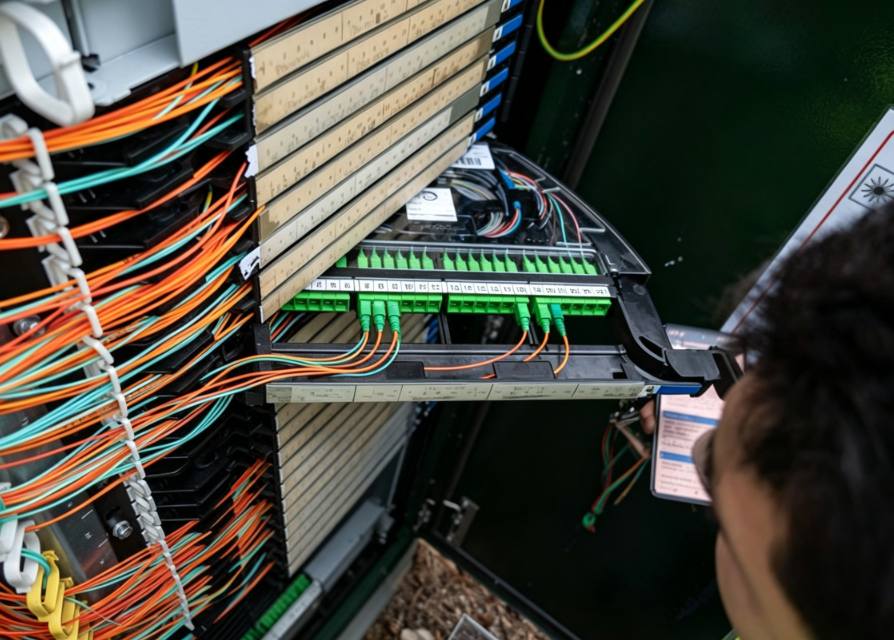
Reckoning with these chokepoints is what restores the value of the access network – provided the spending is sequenced, not sprayed. Four items decide the unit economics: OLT platforms with symmetric capacity; FTTR architecture that terminates in the room instead of dying at an indoor router; pre-connected ODN with no on-site splicing needed; and algorithm-defined maintenance with preemptive feature. None of this is road-map material, but fortunately, desired solutions have already appeared on the horizon. Do that at scale will make the last 100 feet become the springboard where the value of AI is realized.
SYMMETRY BEFORE SPEED
A symmetric channel is now indispensable to the optical distribution network, not a luxury at its edge. OpenVault reports that upstream consumption grew 19.2% in the second quarter of 2026, following 17.9% the prior year and 15.9% the year before. The average upstream use rising 9.3 GB per subscriber, the largest such jump on record, to 58.2 GB a month. The trend only steepens as operators begin to prioritize the return path. Upload Capacity long treated as secondary has to be freed from old constraints.
Indoor Wi-Fi bounds latency and bandwidth as tightly as the outside plant. Fiber-to-the-Room (FTTR) addresses this by carrying the optical data stream to the devices themselves rather than surrendering it to a single Wi-Fi router. Dell’Oro expects FTTR to be a principal driver of broadband access revenue because penetration remains low, and the parallel upgrade to XGS-PON is what makes room-level fiber viable at community scale. That process has already begun.
Symmetry at the OLT only pays off if the passive plant behind it holds its loss budget, and CQT, as a component supplier, has earned their keeps. Supplying ODN hardware interoperate with the GPON, XGS-PON and FTTR equipment, CQT now carryies that experience into networks across the Americas, Gulf, SEA and Latin America. Its terminals are meticulously engineered and tested to embrace a symmetric future.
SNAP, DON’T SPLICE
A clean connection between two fibers determines the reliability of the whole network. Traditional practice requires multiple splices along each route; a single one takes roughly 30 minutes and costs about $30, mostly attributed to skilled labor. Both urban and rural America are now in shortage of skilled technicians. The median cost of a drop has climbed to $400–700, with labor accounting 70% of it. Left unaddressed, these are the forces that will trap FTTR in slow and expensive quagmire.
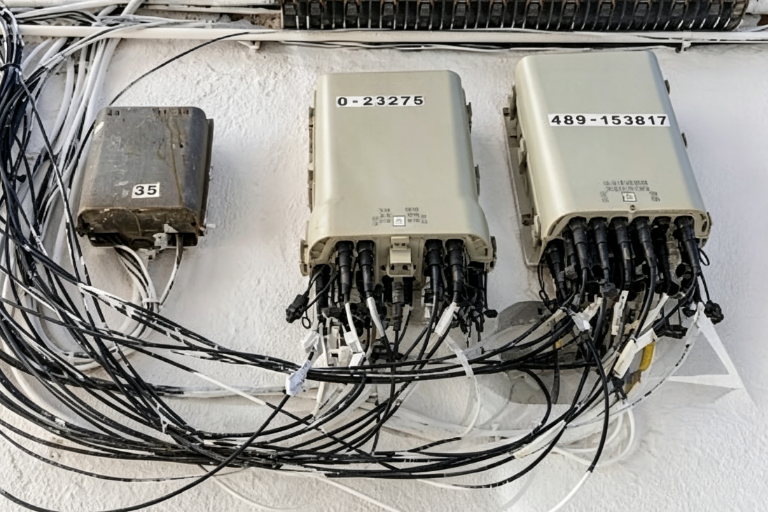
Standardized pre-connection is the way out. When optical distribution devices arrive factory-terminated, the field no longer pays for skilled splicing. If something fails, a technician swaps in a backup unit with little specialized effort. Work that once demanded a master splicer becomes a routine task, and routine is the only form where pre-connection can actually displace field splicing at volume.
Pre-connection hasn’t yet become the default choice, since the last 100 feet looks different in every country, and few suppliers have built for all of them. CQT has designed ODN hardware for more than fifty markets and adapted enclosures to the conditions each one imposes. Over successive product generations, CQT has worked to bring drop cable and connectors under one roof so that pre-connection can be priced as a commodity rather than a premium.
PREEMPTIVE RESPONSE
Fiber needs constant care to hold its performance. When a subscriber reports malfunction, diagnosis has traditionally meant inspecting along the entire line, hardware by hardware. The usual answer is to deploy decentralized diagnostic modules at every critical node, but as FTTR multiplies splits and nodes, the economics of putting hardware everywhere will quietly die out.
Algorithms are beginning to replace hardware. Nokia recently mapped more than a thousand miles of backbone fiber by reading the characteristics of the signal alone. But the far edge, where a feeder splits into countless drops, needs the same real-time visibility and is far more sensitive to per-node cost. The sensible path there is a pairing: a small, cheap device in the field and a general-purpose algorithm above it.
CQT adopted an RFID tag on each port and connection so the passive plant can report its live status, and the algorithm does the reasoning upon it. It couldn’t chart across a thousand miles of fiber as it is not meant to, but it could make the critical junctures of the network tell the truth about themselves.
If you are interested in our products, please contact us: sale@chaoqian.com